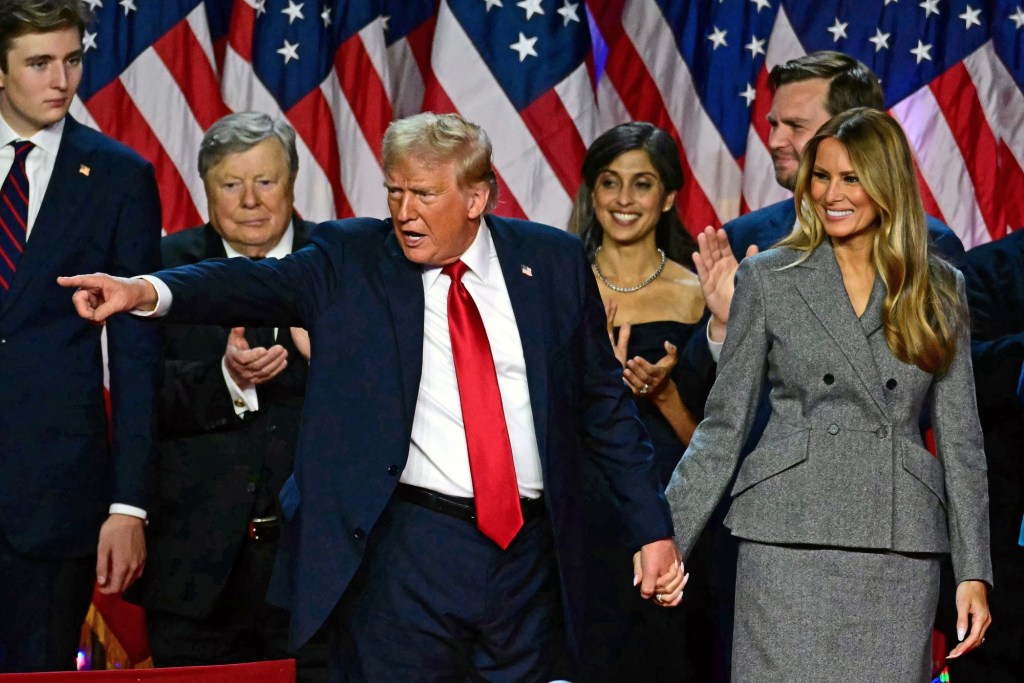
Former President Trump’s comeback is one of the most incredible stories in American politics. Most around the world will no doubt remember him for his rather volatile leadership, his tweets potentially affecting the stock market.
This time around, President-elect Trump has more leeway, even though he is poised to come in with a narrower congressional majority than he did in 2016, as he has remade the Republican Party in his more economically nationalist image. His tariff policies, especially a 10% universal tariff and a 60% tariff on Chinese imports, will attract scrutiny from investors, and potentially drive up costs, because even though Trump has promised to boost American manufacturing, the effect of his industrial policy, if there is any, will take many years to materialize. Analysts had predicted that these tariffs could around 1% to inflation next year, cause the average American household to lose $2,600 in 2025 and cut GDP by 1% over the next year, according to CNBC. And the volatility will increase once Jerome Powell leaves office in 2026 as President Trump will get to appoint a Fed chair that is more to his liking, which will usher in yet again another ultra-low interest rate era, but could trigger potentially another wave of inflation, which could send markets tumbling.
Another factor to watch will be the possibility of widespread domestic unrest. Any deep look on progressive social media platforms will no doubt reveal an electorate that is at least as angry as it was in 2016. And given that likely at least 70 million Americans voted for Vice President Kamala Harris, it suggests a more plugged-in populace than 2016, and therefore a more numerous and tenacious opposition.
On the foreign policy front, the impact of a Trump presidency is uncertain with regard to foreign markets. If he can end the many conflicts around the world as he promised, it could boost economies worldwide. However, one of his plans revealed recently involves European troops patrolling a demilitarized zone in Ukraine. This could be a prelude to Trump throwing Europe under the bus in case of a wider Euro-Russian conflict, which will likely be considered World War 3. In this scenario, while the direct impact to the U.S. will be limited, anyone investing in international markets will face immense turmoil. Already, European markets have tumbled in the wake of Trump’s victory. In the case of more Russian saber-rattling after a hypothetical Ukraine peace deal, expect further drops in Eastern European equities. Bonds of Eastern European countries, in particular, will have significantly higher spreads. This can potentially trigger a flooding of the U.S. market due to a potential withdrawal from NATO, but that is uncertain.
With the trading technology that we have now, reactions will be immediate to international events. As AI becomes more advanced, it can equip investors of all grades to react in a much more informed manner than from 2017 to 2021. But even then, parameters will have to be modified very frequently to fully capture the risk of every action by the president, and his every tweet and every word in it. In order for ordinary people to catch the gains, they have to be sharp and vigilant for the next four years. Even as prices move instantaneously, there remains significant post-event drift to take advantage of. But if an investor is unable to do the hard work to actively navigate this volatile environment, it may be best to pursue low-risk options in less volatile industries healthcare or consumer staples. But no matter one’s risk profile, it pays to always stick to a strategy driven by rigorous analysis of the fundamentals and quantitative factors and reading beyond the headlines rather than pursuing a modus operandi driven solely by emotion and the headlines.
 Jason's World
Leave a comment